Discover · Sacred art & icons
Windows toheaven
The Mother of God in paint, gold, and colour: sacred images that direct our attention to the mystery of her Son.
Honour shown to a sacred image is directed to the person it represents.
Editorial summary · Nicaea II, Definition (787), receiving St. Basil’s teachingChapter 01 · Windows to heaven
Why the Church paints Mary
Because the Word truly became flesh, Christians can depict him in his humanity. Images of his mother and the saints likewise bear witness to his work in human lives. The Second Council of Nicaea distinguished reverence for sacred images from the adoration due to God alone.
An icon is both a real work of art and a confession of faith. Eastern Christians often call icons “windows to heaven”: the phrase describes their purpose in prayer, not a magical property of wood or paint. The honour is directed to the person represented.
Styles and symbolism vary. These six features offer a starting point for attentive looking, not an inflexible rulebook for every Christian image.
- 01
Gold background
The gold ground evokes heavenly glory rather than ordinary landscape. It is an artistic sign of divine light, not a claim that the material itself is divine.
- 02
Three stars
A star on Mary’s forehead and on each shoulder traditionally signifies her perpetual virginity: before, in, and after Christ’s birth. One may be hidden by the Child.
- 03
MP ΘY
The abbreviation of Μήτηρ Θεοῦ — ‘Mother of God.’ These letters identify Mary and confess the truth about her Son: the one she bore is the incarnate Word.
- 04
Blue and red
A deep red or purple mantle and a blue garment are common in Marian icons. Symbolic readings vary across periods and schools; colours are not a universal code, and Mary never becomes divine by nature.
- 05
Her hands
In the Hodegetria, Mary directs attention to Christ. In the Eleusa, mother and child touch cheeks. In Orans images, her raised hands express prayer. Each gesture gives a different emphasis to the same faith.
- 06
The gaze
The gaze can be frontal, tender, or contemplative. Instead of treating every icon as identical, notice how its particular composition draws attention to the relationship between Mary, Christ, and the viewer.
Chapter 02 · Sacred images
A gallery from East and West
Historic icons, devotional paintings, a medal, and sculpture. Their different visual languages share a devotion centred on the incarnate Christ.
Eleusa · Byzantine, 12th century
Our Lady of Vladimir
A Byzantine icon brought to Rus’ in the twelfth century, associated first with Vyshhorod and later Vladimir and Moscow. The Child presses his cheek to his mother’s: a tender image of the Incarnation.
Hodegetria · the Iveron tradition
Panagia Portaitissa
The ‘Keeper of the Gate’ is venerated at Iveron Monastery on Mount Athos. The traditional account of its arrival by sea belongs to the monastery’s devotional history. Mary’s hand points to Christ, the way of salvation.
Ivan Stefanov · Public domain
Resized and converted to WebP; no crop.
Image source · Wikimedia CommonsVirgin of the Passion · traditional icon, Rome
Our Lady of Perpetual Help
The familiar icon venerated in the Church of St. Alphonsus in Rome shows Mary holding the Christ Child while the archangels present instruments of his Passion. The Child clasps his mother’s hand; a loosened sandal adds a tender human detail. Entrusted to the Redemptorists in 1866, the image joins maternal consolation to Christ’s redeeming love.
Unknown artist · Public domain
Resized and converted to WebP; no crop.
Image source · Wikimedia CommonsHodegetria · Jasna Góra, Poland
Our Lady of Częstochowa
Venerated at Jasna Góra since the fourteenth century, this icon bears the remembered wounds of an attack in 1430 and subsequent restoration. Mary directs the viewer to her Son; he blesses while holding the book of the Gospels.
Orans · Novgorod, 12th century
Our Lady of the Sign
The Mother of God raises her hands in prayer, with Christ shown in a medallion at her breast. Christian contemplation connects this image to Isaiah’s sign of the virgin who bears Emmanuel, God with us.
Unknown artist · Public domain
Resized and converted to WebP; no crop.
Image source · Wikimedia CommonsWilliam-Adolphe Bouguereau · 1900
The Virgin with Angels
A Western devotional painting of Mary and the Christ Child surrounded by angels. Its idealized figures and luminous colour belong to Bouguereau’s academic painting rather than the visual conventions of a Byzantine icon.
William-Adolphe Bouguereau · Public domain
Resized and converted to WebP; no crop.
Image source · Wikimedia CommonsDevotional medal · the Rue du Bac tradition
Our Lady of the Miraculous Medal
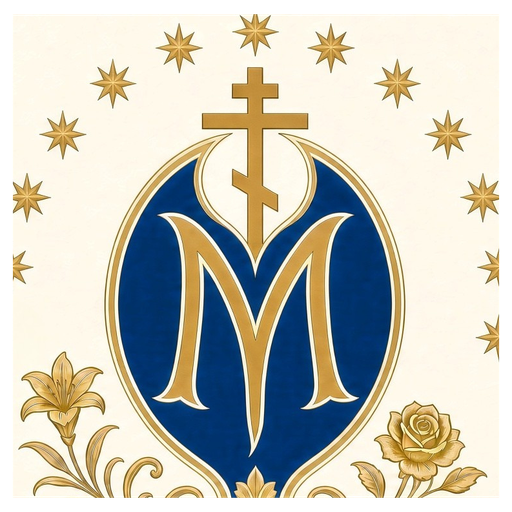
The front shows Mary with outstretched hands and the invocation asking her prayers. The reverse joins the cross and Marian M above the hearts of Jesus and Mary, encircled by twelve stars. The design belongs to the account of St. Catherine Labouré’s 1830 encounters in Paris. The medal is a sacramental: a call to faith and prayer, not a charm.
The Miraculous Medal accountOur Lady of Pompeii · traditional devotional painting
Our Lady of the Rosary
Mary and the Child offer rosaries to St. Dominic and St. Catherine of Siena in the image associated with the shrine at Pompeii. This devotional composition brings different centuries together; it is not a picture of a single documented historical meeting. The beads direct contemplation toward the mysteries of Christ.
Pray the Holy RosaryUnknown artist · Public domain
Resized and converted to WebP; no crop.
Image source · Wikimedia CommonsAlfonso Balzico · sculpture, Rome
Our Lady of the Brown Scapular
At Santa Maria della Vittoria in Rome, Balzico’s sculptural group depicts Mary giving the scapular to St. Simon Stock. The artwork expresses a venerable Carmelite tradition, not contemporary evidence of the vision. The garment signifies belonging to Mary and following Christ in prayer, the sacraments, and works of mercy.
The Brown Scapular accountAlfonso Balzico · Public domain
Resized and converted to WebP; no crop.
Image source · Wikimedia Commons
Chapter 03 · Guadalupe
A close reading
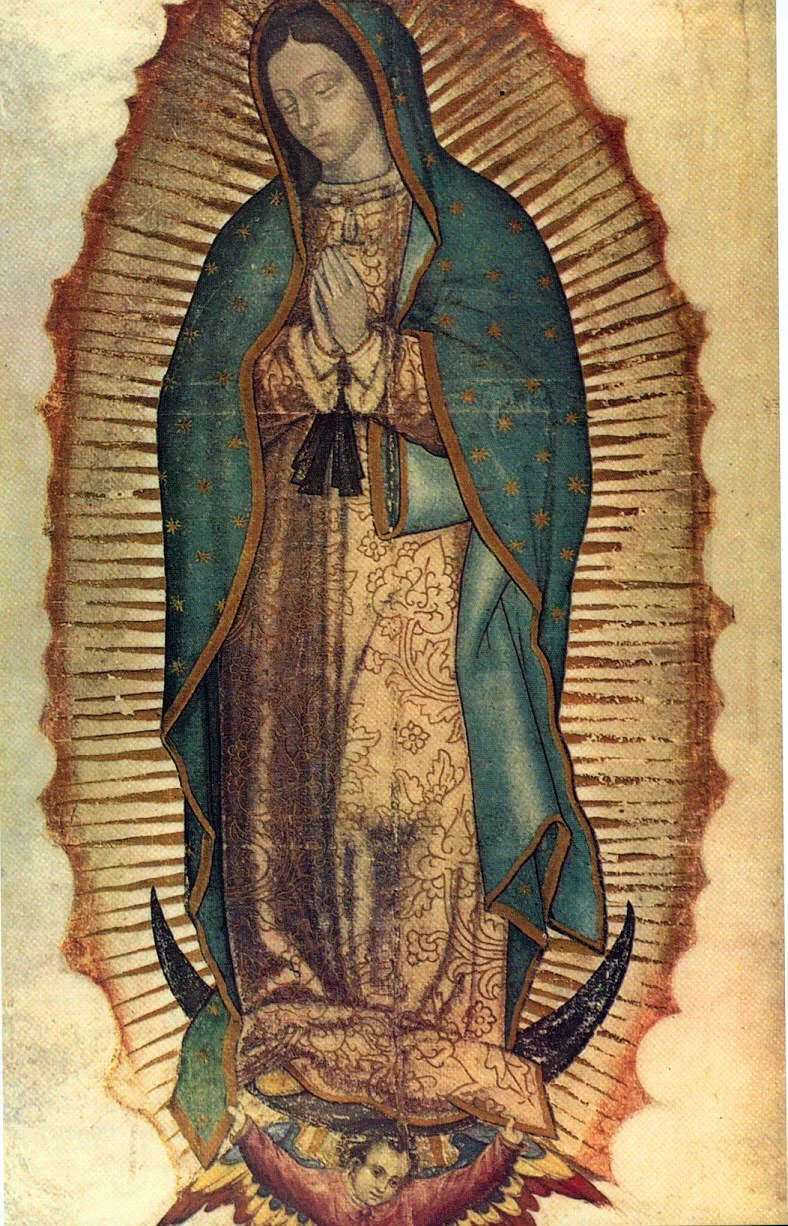
The image venerated at Guadalupe is associated with the traditional account of the 1531 apparitions to Juan Diego. These are devotional readings of its visible details, not scientific findings or additional dogmas.
Unknown artist · Public domain
Resized and converted to WebP; no crop.
Image source · Wikimedia CommonsDetail 1
The star-covered mantle
The stars invite a heavenly reading of Mary’s dignity. Claims that they reproduce an exact historical sky are devotional interpretations, not an established conclusion asserted here.
Detail 2
The moon under her feet
The crescent recalls the Woman of Revelation 12:1. Christian readers see Mary’s place within God’s victory; no celestial object is itself an object of worship.
Detail 3
The rays of the sun
The surrounding radiance evokes the Woman ‘clothed with the sun.’ This biblical imagery points to glory received from God, not a separate divine power belonging to Mary.
Detail 4
The surrounding glory
The almond-shaped field of rays resembles the mandorla of sacred art. It frames the figure within a visual language of heavenly light.
Detail 5
The dark waist ribbon
Often read in Guadalupe devotion as a sign of pregnancy, the ribbon focuses contemplation on Mary as the mother who bears Christ. Historical interpretations of individual motifs should be distinguished from defined doctrine.
Detail 6
The angel
The angel supports the figure and gathers the garments at her feet. Devotional readings see heavenly service and a meeting of earth and heaven in this small, vivid detail.