Given by Our Lady, sung by the poor, preached by the saints. The Rosary is a Christ-centred prayer said with Mary — a Gospel in miniature you can carry in your hand.Pray the Rosary ↓
Today, Thursday
Luminous Mysteries
The public ministry · Thursday
Chapter 01 · Where the Rosary came from
A gift from the Mother of God
The Rosary comes to us across eight centuries — through a French preacher, a naval battle, an unlettered French girl, and three Portuguese shepherds. Its heart never changes.
To Jesus through Mary
The Rosary keeps Mary’s words at Cana — ‘Do whatever he tells you.’ (John 2:5, RSV-CE) — before us at every decade. She leads us to her Son.
A gospel in miniature
The twenty mysteries are the whole story of salvation. To pray them is to walk with Christ from the Annunciation to the Cross, from the Empty Tomb to the throne of heaven.
A prayer for our own time
The Popes of the twentieth century — St. Pius X, Pius XII, St. John XXIII, St. Paul VI, St. John Paul II, Benedict XVI, Francis — have all called us back to the Rosary as the prayer of families and of the world.
1214
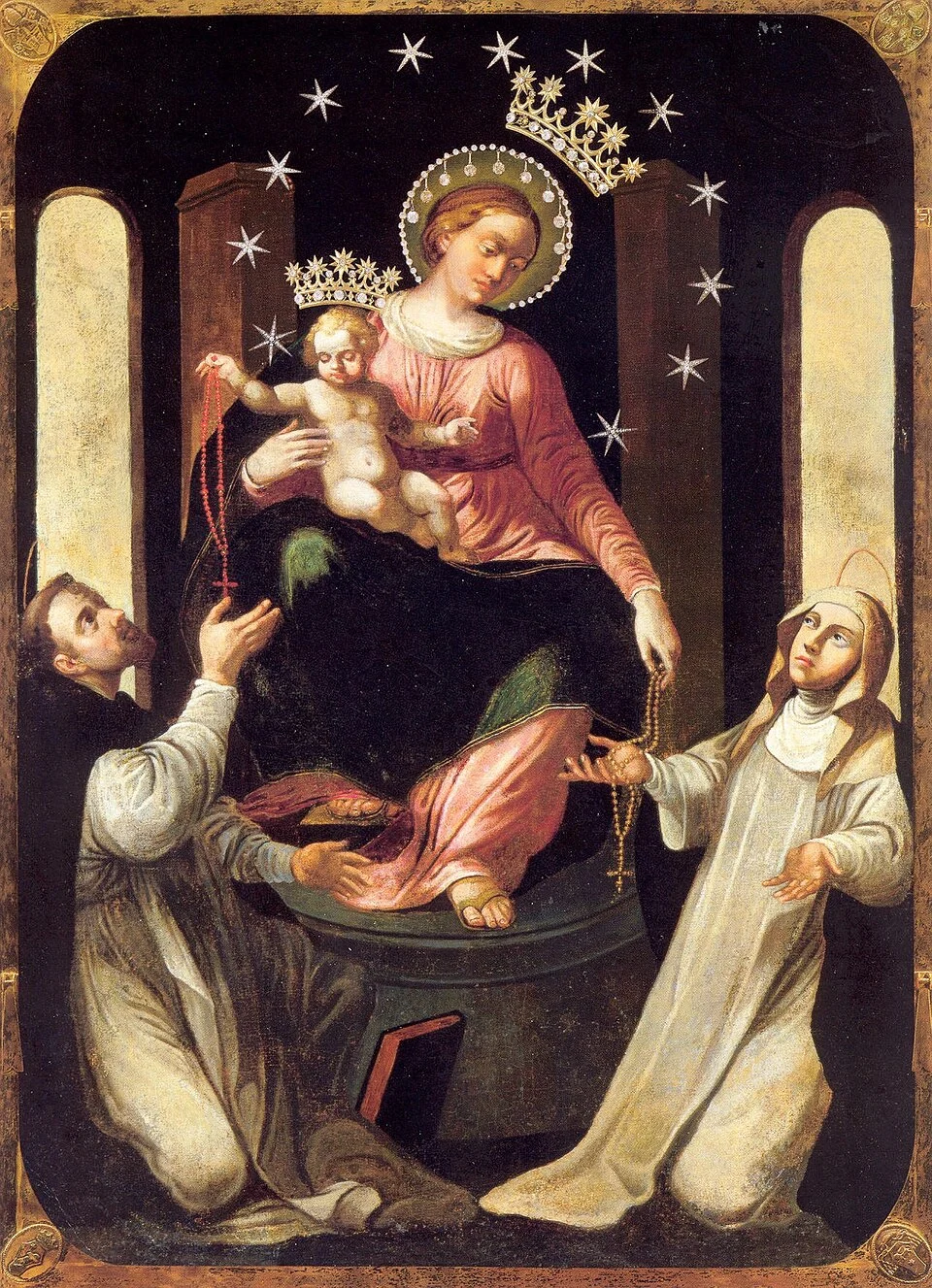
According to a beloved Dominican tradition, the Blessed Virgin Mary appeared to St. Dominic Guzmán in the church of Prouille in southern France while he was struggling to convert the Albigensians.
—
She gave him a chaplet of beads — the psalter of the poor — and asked him to preach it: fifteen mysteries, one hundred and fifty Hail Marys, as many as the Psalms of David.
1569
Pope St. Pius V formally established the Rosary in the Latin Church with the bull Consueverunt Romani Pontifices, drawing together older monastic and lay practices into the form we know today.
1571
Battle of Lepanto: the Christian fleet, praying the Rosary, defeats the Ottoman navy. Pius V institutes the feast of Our Lady of Victories, later renamed Our Lady of the Rosary — kept on 7 October.
1858
At Lourdes, the Immaculate Conception herself prays the Rosary silently at St. Bernadette's side — the Aves passing on the beads while she waits for the Glory Be.
1917
Lúcia’s account of 13 October 1917 at Fátima identifies Mary as the Lady of the Rosary and recalls her request for daily prayer. See the sanctuary’s Narrative of the Apparitions.
2002
St. John Paul II, in Rosarium Virginis Mariae, adds the five Luminous Mysteries of the public ministry of Christ — from the Baptism to the Institution of the Eucharist.
01
The Rosary is a Christ-centred prayer said with Mary. On each Hail Mary bead you pray while your heart meditates on a scene from the Gospel — a 'mystery.' Twenty scenes in all: Joyful, Sorrowful, Glorious, and Luminous.
02
You pray one set of five mysteries per day. Traditionally: Joyful on Monday and Saturday; Sorrowful on Tuesday and Friday; Glorious on Wednesday and Sunday; Luminous on Thursday. You may choose freely at any time.
03
The prayer of the beads is the outer form; contemplation of Christ in the mysteries is its heart. This summarizes the teaching of St. Paul VI in Marialis Cultus, §47, cited by St. John Paul II in Rosarium Virginis Mariae, §12.
From the Christian East
The prayer rope · a companion to the Rosary
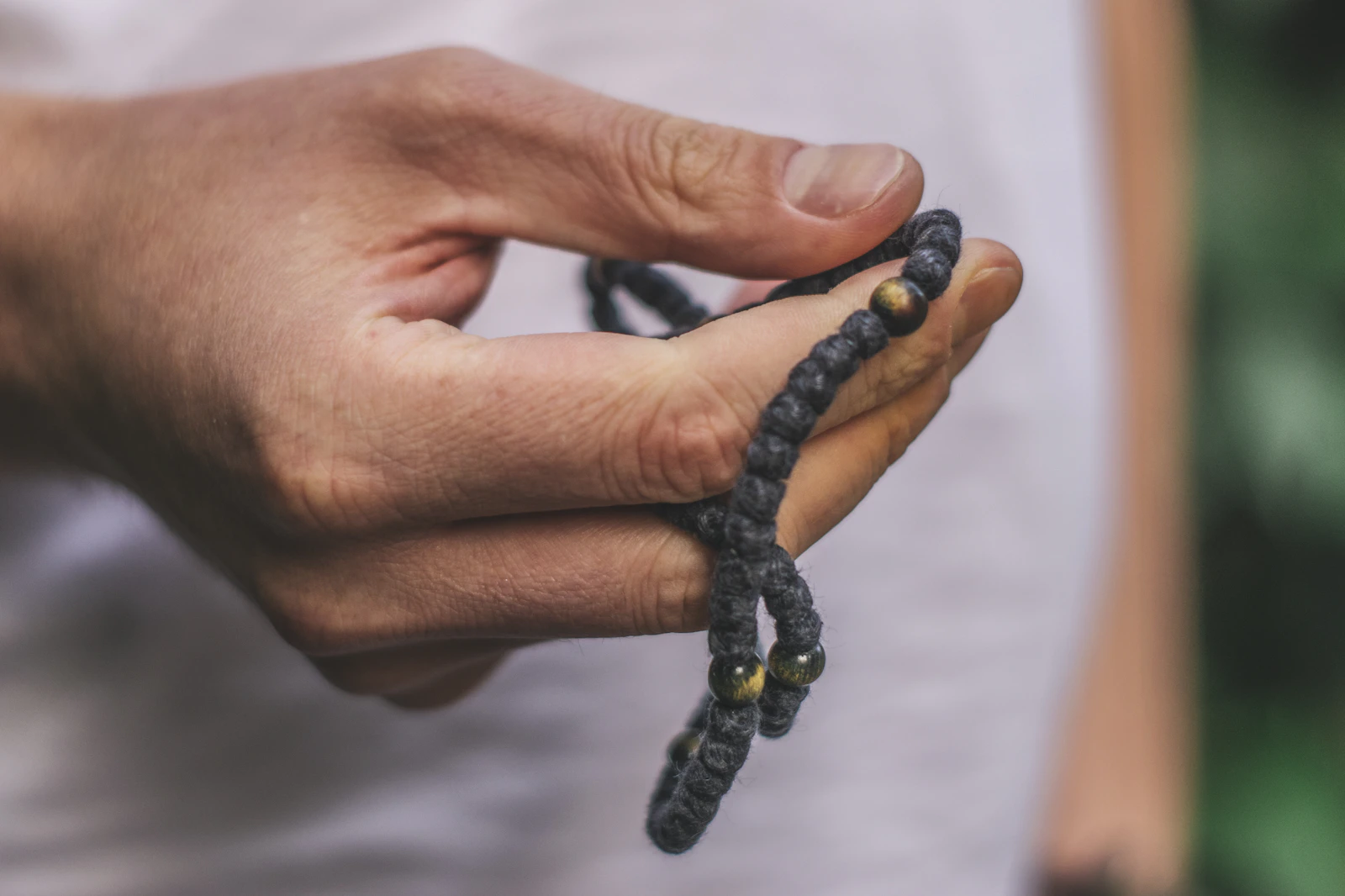
Melkite and other Byzantine Christians use a knotted prayer rope—komboskini or chotki—to accompany the Jesus Prayer. Its quiet invocation can complement the Rosary’s contemplation of Christ with Mary, while each retains its own character.
“Lord Jesus Christ, Son of God, have mercy on me, a sinner.”
Can you sing this prayer? Volunteer singers and choirs are warmly invited to contribute a recording for this free prayer treasury. Please use the published prayer text and contact us about sharing a recording you own and permit us to use.
In the Seventh Rose, St. Louis-Marie de Montfort describes the Rosary as a spiritual crown of roses offered to Jesus and Mary. Each Hail Mary is like giving Our Lady a beautiful rose; the Rosary prayed devoutly becomes a crown of heavenly flowers that do not fade.
He recounts the devotional tradition of the Jesuit Brother Alphonsus Rodriguez: a red rose appeared at each Our Father, and a white rose at each Hail Mary. The roses were equal in beauty and fragrance, differing only in colour.
Montfort calls the complete Rosary a large crown and five decades a little wreath. This is devotional imagery, not a promise that visible flowers will appear.
The Rosary turns our attention to the mysteries of Christ with Mary. The Brown Scapular carries that relationship into daily life: a small sign of belonging to the Carmelite family and of learning to follow Jesus as his mother did. Prayer on our lips and fidelity in our lives belong together.
The scapular is a sacramental, not a sacrament, a charm, or an automatic guarantee of salvation. Christ alone is our Saviour. Mary’s intercession leads to him, and the sign calls for prayer, the sacraments, works of mercy, and a life shaped by the Gospel.
John Paul II describes the scapular as a commitment that becomes a permanent orientation of Christian conduct: prayer, frequent reception of the sacraments, and works of mercy (Message to the Carmelite Family, 2001, §5).
Beneath thy shelter · Sub tuum præsidium
Beneath thy shelter we take refuge, Holy Mother of God; despise not thou our prayers in our necessities, and deliver us always from all dangers, Virgin glorious and blessed.
The Raccolta (1857), no. 76 · Ambrose St. John translation
Can you sing this prayer? Volunteer singers and choirs are warmly invited to contribute a recording for this free prayer treasury. Please use the published prayer text and contact us about sharing a recording you own and permit us to use.
For enrolment, speak with a priest or the local Carmelite community about the Church’s blessing and enrolment rite. Wearing it does not enrol someone automatically. This reflection is optional; it adds no beads or required prayers to the Rosary.
About the familiar Rosary–Scapular saying
This third-person wording paraphrases a popular Rosary–Scapular saying, often attributed to Our Lady or linked to St. Dominic. We have not verified an early primary source for the saying or its attribution. It is not presented here as an authenticated promise. Its devotional meaning is trust in Christ’s saving grace, with Mary’s intercession—not salvation through objects apart from conversion.
Popularized by Venerable Patrick Peyton, C.S.C., the “Rosary Priest.” The slogan is credited to Al Scalpone, who wrote it for Family Theater in 1947. St. John Paul II also used it in Rosarium Virginis Mariae, §41 (16 October 2002).
Praying together gives a family time to turn from distraction toward Christ and toward one another. In the Rosary, Mary helps parents, children and grandparents contemplate his life while bringing their own joys, worries and needs before him. Shared prayer can nurture listening, gratitude, forgiveness and the patience to begin again; its fruit is meant to become love in ordinary daily life. The saying is an invitation to faithful devotion, not a guarantee against hardship, and prayer should accompany practical care and help when needed.
Keep the whole Rosary in your pocket: the order of the beads and every essential prayer, with the Carmelite sign of Our Lady. Choose your language — English & Latin, Spanish, French, Arabic or Chinese — then print it as a pocket holy card to cut out and carry, or as a full page for the prayer corner at home.
Print language
Recording not yet available
Can you sing this prayer? Volunteer singers and choirs are warmly invited to contribute a recording for this free prayer treasury. Please use the published prayer text and contact us about sharing a recording you own and permit us to use.