Our charter
EditorialStandards
Everything on this site is bound by six commitments, a strict vocabulary for the Church’s judgements on apparitions, and a fixed hierarchy of sources. This page is the linked explanation behind every status label you will meet.
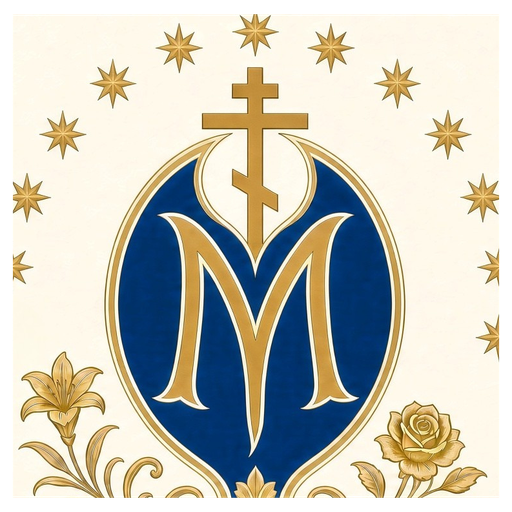
The emblem unites West and East: the Latin monogram M within a Byzantine mandorla, the three-bar cross, the lily and the rose, beneath twelve stars.
Chapter 01
Who we are
Theotokos Mater Dei is a work of The Gate to Heaven Ministry.
Its creator, Fred Bachour, is a former seminarian who, after eight years of seminary formation, now lives his vocation as a faithful lay Melkite Catholic. Raised in the Latin tradition, he came to cherish the distinct spiritual riches of East and West. Inspired by St. Carlo Acutis’s use of technology for evangelization, St. John Paul II’s vision of the Church breathing with both lungs, and St. Louis de Montfort’s Christ-centred Marian devotion, this work gathers prayers, teachings, and sacred traditions to help others draw nearer to Jesus through his Mother.
This is a lay offering of study, prayer, and charitable defense of Catholic truth, grounded in Scripture, Tradition, and the Church’s teaching authority. It is not an official website of the Holy See, a diocese, a shrine, or a religious institute, and its founder does not speak as the Church’s teaching authority. Careful sources and a clear distinction between official texts and original reflections remain essential to the mission.
Read the full testimony · Why we existChapter 02
Six editorial commitments
- 01
Faithful to Catholic teaching
We use the Catechism, Scripture, Holy See documents, official diocesan and shrine materials, and established Catholic sources. Where the Church has not spoken, we say so.
- 02
Accurate about apparitions
We never describe a case as simply “Vatican approved.” Every entry states the exact status and the authority that gave it: diocesan recognition, permission for devotion, nihil obstat, or another official judgement.
- 03
Clear distinction of sources
Official Church documents, historical records, witness testimony, devotional tradition, and commentary are labelled separately on every page.
- 04
Pastoral, never sensational
No fear-based prophecy, no conspiracy claims, no financial pressure and no promises of guaranteed healing. Personal testimonies are clearly identified and are not presented as verified supernatural events, official Church approval, or binding Catholic teaching.
- 05
Accessible to everyone
Plain English, mobile-first pages, a large-text mode, strong contrast, and captions or transcripts for any media.
- 06
Non-commercial at the beginning
No intrusive advertising. If donations are ever needed, finances will be transparent, and we will never sell promises, blessings, or spiritual favours.
Chapter 03
How the Church discerns apparitions
Private revelations, even when recognized, do not belong to the deposit of faith. Their role, the Catechism teaches, is “to help live more fully by it in a certain period of history” (Catechism of the Catholic Church, §67 · excerpt). Catholics are never obliged to believe them. The Church’s task is to judge whether a devotion is safe, fruitful, and free of error — and she does so with a precise vocabulary. We use that vocabulary and never a generic “approved.”
Our five status labels
- Diocesan judgement · see scope
- A judgement by the competent local bishop. Its scope must be read in the entry: Lourdes (1862) recognizes the apparitions; Fátima (1930) declares the visions worthy of belief and permits public devotion; Kibeho (2001) recognizes only the three named initial Marian testimonies. Permission for a devotion is not automatically a declaration of supernatural origin.
- Related Holy See act or document
- A related papal or dicastery document is available, such as a liturgical act, canonization, theological commentary or shrine designation. This is a source label, not an apparition verdict. Neither canonization of a visionary nor a papal visit authenticates every reported message.
- Nihil obstat for devotion
- Under the 2024 Norms of the Dicastery for the Doctrine of the Faith, the bishop, with the Dicastery’s approval, may declare that nothing prevents the faithful from prudent adherence to a devotion and its message — without declaring its supernatural origin.
- Historical shrine and devotion
- Established shrines and devotions whose founding accounts are distinguished from a modern decree on supernatural origin. Guadalupe’s liturgical honours and Juan Diego’s canonization are documented separately; Knock has its own commissions and later shrine designation. Age, popularity and papal honours do not replace a case-specific judgement.
- Under discernment / not included in this collection
- Cases still under examination by the competent authority, or not included in this collection because their status is unclear or negative. This label does not assert a favourable judgement.
The 2024 Norms of the Dicastery for the Doctrine of the Faith
On 17 May 2024 the Dicastery published new Norms for Proceeding in the Discernment of Alleged Supernatural Phenomena. As a rule, neither the bishop nor the Holy See now declares a phenomenon to be of supernatural origin; the bishop, with the Dicastery’s approval, reaches one of six conclusions:
1
Nihil obstat
Signs of grace and spiritual fruits are recognized, with no particularly critical or risky aspects detected so far. The bishop may appreciate the pastoral value without declaring supernatural authenticity or requiring belief.
2
Prae oculis habeatur
Positive signs are present, but some elements need clarification; careful discernment continues.
3
Curatur
Critical elements exist, yet the phenomenon is widespread with verifiable fruits; the bishop is asked not to encourage it but to purify it.
4
Sub mandato
The problems lie with a person or group misusing the phenomenon; the Holy See entrusts its pastoral direction to the bishop or a delegate.
5
Prohibetur et obstruatur
Critical issues and risks outweigh positive elements; the faithful are told that adherence is not permitted.
6
Declaratio de non supernaturalitate
The bishop, with the Dicastery, declares that the phenomenon is not supernatural, on the basis of concrete evidence.
Source: Dicastery for the Doctrine of the Faith, Norms (2024). The new norms do not retrospectively rename older judgements as nihil obstat. Earlier decisions retain their particular scope unless the competent authority revises them.
Chapter 04
Suggested source hierarchy
Scripture editions & quotations
Scripture quotations on this devotional website use the Revised Standard Version Catholic Edition (RSV-CE), not RSV-2CE. The Revised Standard Version of the Bible: Catholic Edition, copyright © 1965, 1966 the Division of Christian Education of the National Council of the Churches of Christ in the United States of America. Used by permission. All rights reserved.
The Canadian English-language Mass lectionary uses an adapted NRSV; this website’s selected RSV-CE text is not presented as that liturgical edition or as a bishops’ endorsement. Historical prayers, quotations within historical documents, and existing musical settings retain their identified original wording. Editorial explanations are not Scripture quotations.
Direct quotations identify their author, work, passage or date, and the linked edition wherever available. Ellipses mark omissions. Editorial summaries appear without enclosing quotation marks. Reported apparition words are testimony in the cited account, not independently recorded speech. When wording or attribution cannot be verified, we use an explicitly labelled reflection rather than invent a quotation.
Prayer texts are not composed or modernized for this website. We use cited historical texts, original-language prayers, and identified publisher editions. The full Montfort consecration follows F. W. Faber’s 1863 translation; Scripture selections use RSV-CE. Historical texts and musical settings keep their attributed original wording and are not relabelled as RSV-CE. Editorial reading plans and explanations are distinct from prayer texts. Historical indulgence notices in source books are not presented as current Church grants.
Prayer recordings require a verified recording licence, performer attribution and a match to the named prayer. Language and excerpt scope are identified. No AI-generated speech or unrelated music is substituted. Prayers without a sourced recording are marked “Recording not yet available”.
Quotation and citation review · 9 October 2026. This editorial review is not ecclesiastical approval of the website.
When sources disagree, the higher authority governs. Every entry cites at least one source from the first two tiers.
- 1Holy See, Vatican, and Dicastery documents
- 2The relevant diocese, bishops’ conference, or official shrine
- 3The original decree, historical archive, or scholarly publication
- 4The Catechism, Scripture, and official liturgical texts
- 5Trusted explanatory Catholic sources such as EWTN and Ascension Press
- 6Other devotional material — only if clearly identified and appropriately sourced
Images are reproduced from public-domain and Creative Commons sources with attribution on every page. Shrine photography that is not freely licensed is replaced by illustrative imagery, clearly labelled.
Chapter 05
Essential disclaimer
A short form of this disclaimer appears in the footer of every page. Nothing here replaces the guidance of your pastor, your bishop, or the teaching of the Church.
Chapter 06
Review and corrections
Every entry shows its last review date. Church status, dates, and sources are re-checked against the shrine and diocese at least once a year and whenever the competent authority issues a new judgement.
If you find an error — a misstated status, a wrong date, a broken source — please tell us. Corrections are made promptly and noted on the page.
Send a correction