About the treasury
A Catholic treasury,a shared mission
A place of study, prayer, and beauty about the Blessed Virgin Mary — Latin and Eastern Catholic, one Mother, one Church. Inspired by the example of St. Carlo Acutis: to gather what the Church herself has said, sourced with care, and to offer it freely.
Our promise
Non-commercial. No intrusive advertising. If donations are ever needed, finances will be transparent — and we will never sell promises, blessings, or spiritual favours.
Chapter 01 · A lay Catholic’s mission
Why we exist
My desire to build this website grew from a love for the Church and the example of St. Carlo Acutis. The Milanese teenager, who died at fifteen in 2006, used technology to share his love for the Eucharist. His exhibition of Eucharistic miracles showed me that the digital world can become a place of evangelization: a doorway to prayer, truth, and an encounter with Christ.
My own journey has been shaped by years in the Church and eight years of seminary formation. I am a former seminarian, and today I live my vocation as a faithful lay Catholic. I did not go on to ordination, but the call to holiness remains. Through Baptism, every Christian is called to know, love, and serve the Lord.
I grew up as a teenager in the Latin rite. During my seminary years, I discovered that I was a Melkite Catholic. Studying and living the liturgical life of both East and West deepened my appreciation of their distinct spiritual riches. I came to love their shared faith without needing to make their expressions identical.
St. John Paul II’s call for the Church to breathe with her two lungs has always touched me. It gives words to the communion I cherish and the unity for which I pray. His encouragement not to be afraid of holiness reminds me that becoming a saint is not an ambition reserved for priests or religious. It is a vocation for all of us.
St. Louis de Montfort’s True Devotion to the Blessed Virgin has also shaped this desire. Authentic devotion to Mary never ends with Mary: it leads us more deeply to Jesus Christ. To entrust ourselves to her is to learn her faith, humility, and obedience, and to hear her words at Cana: ‘Do whatever he tells you.’
I created Theotokos · Mater Dei with the hope of gathering the Church’s Marian prayers, devotions, teachings, and sacred traditions into a growing treasury. I want it to be a place where someone can pray, study, ask sincere questions, and discover why the Church loves and honours the Mother of God.
I also want to stand faithfully in defence of Catholic truth. Marian teaching is often misunderstood or challenged. My response must not be hostility, but a clear and charitable witness grounded in Scripture, Tradition, and the Church’s teaching authority. Defending Mary’s place in the faith ultimately means confessing the truth about her Son.
I offer this work as a lay member of the Church, not as her teaching authority. Careful sources matter; so does distinguishing an official text from an original reflection. My hope is that this small work will help others remain faithful, grow in prayer, and draw nearer to Christ through his Mother—with the living breath of both East and West.
Stage 1
Now — Foundations
Seventeen apparition and devotional accounts, four sourced dogma guides, the illustrated Rosary in four languages, the shared prayer treasury, Roman calendars and selected Eastern feasts, editorial standards, and the East & West chapter.
Stage 2
Soon — Depth
A growing library of Church documents; complete local Eastern ordines; further prayer editions and carefully reviewed translations; spoken Rosary and Paraklesis audio; more shrines from Asia and Africa.
Stage 3
Later — Community
Verified contributors, editorial roles for scholars and pastors, translated pages reviewed by native speakers, an atlas of every recognised Marian shrine in the world.
Chapter 02 · The emblem
A coat of arms for the Mother of God
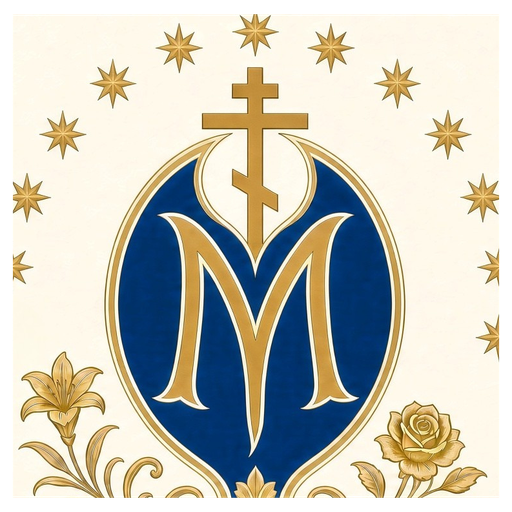
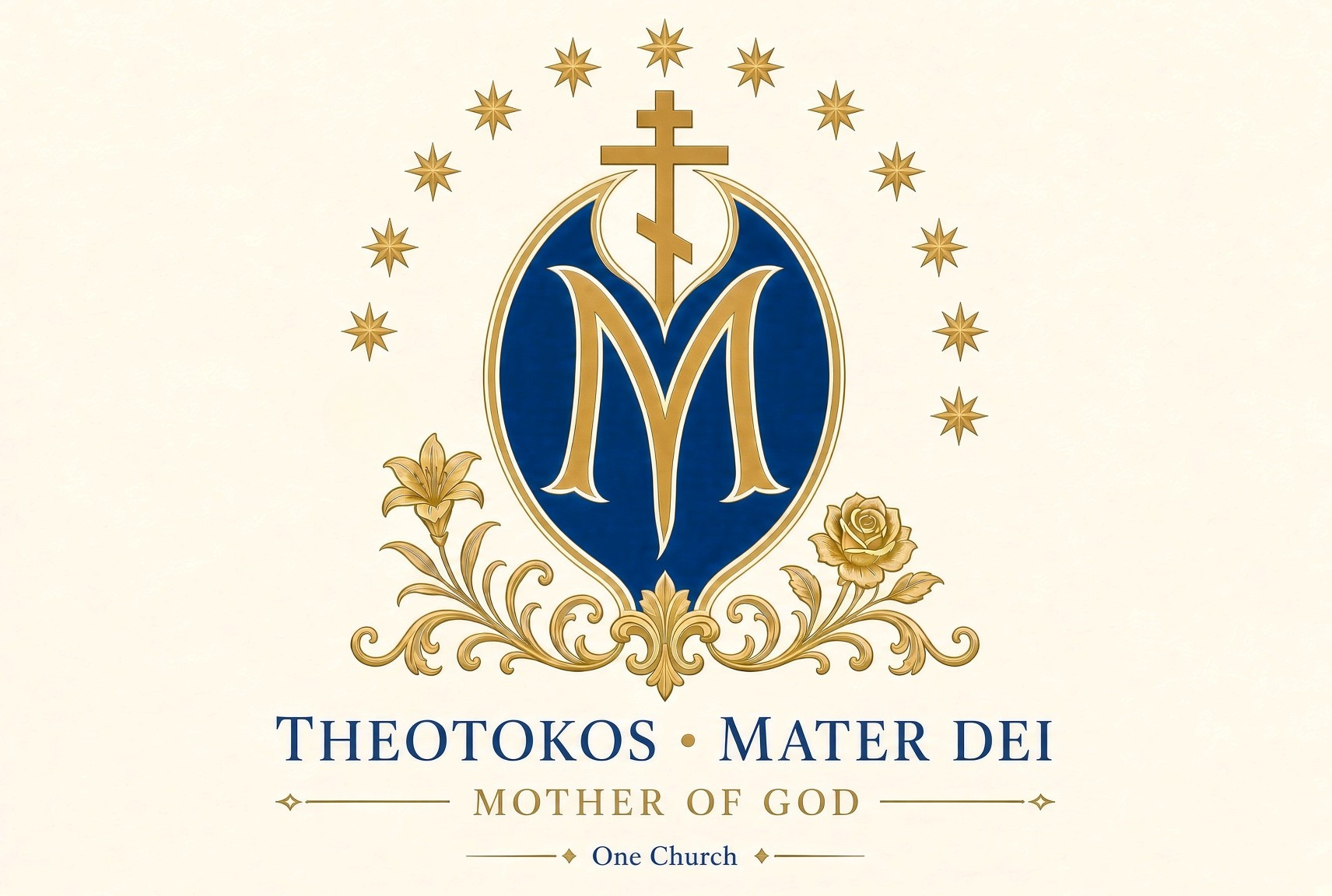
Every symbol in the emblem of Theotokos · Mater Dei is drawn from the Church's own vocabulary. It unites East and West in a single image; nothing is decorative alone.
Symbol 01
The mandorla
The deep-blue almond-shaped field is the mandorla — an ancient sign of heavenly glory in Eastern Christian art. It surrounds Christ in the Transfiguration and Mary in the Dormition. In this emblem, blue represents her humanity clothed in divine grace.
Symbol 02
The Marian M
The gold monogram M is the Latin Marian cypher — the letter of the Miraculous Medal of 1830, the seal of countless Catholic churches. It anchors the emblem in the West and expresses this treasury’s purpose: through Mary to Jesus.
Symbol 03
The three-bar cross
The cross crowning the mandorla is the Suppedaneum Cross of the Eastern Churches — Byzantine, Slavic, and Melkite. Its upper bar is the titulus ('INRI'), its lower slanted bar the footrest that points to the two thieves: one up, one down. It marks the emblem as belonging to both lungs of the Church.
Symbol 04
Twelve stars
Twelve stars recall the tribes of Israel and the apostles. In this emblem, they remind us that Mary is the Mother of the whole Church. The biblical image is found in Revelation 12:1.
And a great portent appeared in heaven, a woman clothed with the sun, with the moon under her feet, and on her head a crown of twelve stars;
Revelation 12:1 · RSV-CE Symbol 05
The lily
On the left, a Madonna lily — the flower of the Annunciation, symbol of Mary's virginity, painted at the Angel's feet in a thousand Western altarpieces from Fra Angelico onwards.
Symbol 06
The rose
On the right, a golden rose — the flower given by the Pope every fourth Sunday of Lent, and by the Mother of God herself to Juan Diego in December 1531. 'Rosa Mystica' is one of the titles of the Litany of Loreto.
Symbol 07
Blue, gold, and ivory
The palette is the Church's own: Marian blue for the mantle of the Theotokos; gold for the Light of God; ivory for the parchment of Scripture on which every doctrine of Mary is written. No modern colour, nothing decorative for its own sake.
The emblem was drawn especially for this treasury: nothing in it is stock, nothing is generic. If you would like to use it for a parish exhibition or for a Catholic publication, please write to us — we grant permission freely for reverent, non-commercial use.
Ad Iesum per Mariam
A treasury is built by many hands. If you can help — a correction, a translation, a scholar's note — we would be honoured.