Theotokos · Mater Dei
A Catholic treasury of Our Lady
A full account for the parish
Our Lady of the Miraculous Medal
Chapel of the Daughters of Charity, 140 rue du Bac, Paris · France
- Reported events
- 18 July, 27 November and December 1830
- Witness
- St. Catherine Labouré
- Feast / local observance
- 27 November
Overview
In 1830, Catherine Labouré was a young novice among the Daughters of Charity in Paris. The life before her was one of service, not public attention. Yet in the chapel at the Rue du Bac she reported encounters with Mary that would give the Church one of its most familiar devotional objects: the Miraculous Medal. The first encounter, during the night of 18–19 July, drew her toward the chapel and the altar, where she received consolation and a demanding mission.
On 27 November, Catherine described a vision of Mary with rays streaming from her hands and an invocation surrounding her: ‘O Mary conceived without sin, pray for us who have recourse to you.’ This follows the Rue du Bac chapel’s English account of the November encounter. A medal was to be made according to the pattern she saw. Its reverse joined a cross and the letter M with the hearts of Jesus and Mary. After Catherine entrusted the account to her confessor, the medal was authorized and began to circulate in 1832.
Its beauty is a whole relationship expressed in something small enough to carry: Christ’s Cross, his mother’s intercession, and the invitation to ask for grace. It is not a charm or a guarantee against suffering. Catherine herself offers the clearest interpretation. She spent the ensuing decades caring for elderly people while her identity as the visionary remained largely hidden. The medal became famous; her daily answer to the encounter remained humble service.
Church discernment
Diocesan judgement · see scope · Related Holy See act or document
Striking of the medal authorized by Archbishop Hyacinthe-Louis de Quélen of Paris (1832); canonical inquiry concluded favourably (1836); feast of the Miraculous Medal granted by Leo XIII (1894); Catherine Labouré canonized by Pius XII, 27 July 1947.
The full account · 5 min read
A small medal and a life of hidden service
The narrative follows the chapel’s account of Catherine’s testimony. Short English quotations follow its translated devotional wording; authorization of the medal is distinguished from canonization and from a modern apparition decree.
A farmer’s daughter comes to Paris
Catherine Labouré came from a farming family in Burgundy. The death of her mother while she was young and the responsibilities of household life formed part of the world she knew before entering religious life. In 1830 she arrived at the Paris motherhouse of the Daughters of Charity. Their vocation, shaped by St. Vincent de Paul and St. Louise de Marillac, joined prayer to practical service of people in need.
Paris was entering another period of political upheaval. But the account of Catherine’s first Marian encounter begins inside the quiet routine of a novice’s house. During the night of 18–19 July, she reported being awakened and led to the chapel by a child. There she encountered the Lady she recognized as Mary. The narrative places the experience close to the altar, not outside the prayer and worship of the Church.
Consolation beside the altar
Catherine described approaching Mary and kneeling beside her. The account preserves the intimacy of that encounter together with warnings of difficulties ahead. Consolation did not mean that Catherine would be spared opposition or that France would avoid turmoil. A task was being entrusted to her, and it would require patience. The invitation to come to the altar directed her toward the place where Christ gives himself to his people.
That setting is essential to the story’s meaning. Mary’s maternal nearness does not offer a route around Jesus or a private spiritual world sufficient in itself. It leads Catherine back into the Church’s worship. The altar is not scenery behind a more interesting apparition; it is the centre toward which the encounter points. The grace sought through Mary belongs to her Son, whose self-giving forms the life of the Church.
Sources: [1]
The evening of the medal
On 27 November, during community prayer, Catherine reported another vision. Mary appeared standing above the globe, with the serpent beneath her feet. The account includes an image of a small globe offered to God and then rays shining from jewelled rings on Mary’s hands. Catherine understood the rays as graces given to those who ask; the stones without rays represented gifts for which people did not think to ask.
An oval inscription surrounded the figure: ‘O Mary conceived without sin, pray for us who have recourse to you.’ This is the wording of the Rue du Bac chapel’s English account of 27 November 1830. Catherine was asked to have a medal made according to what she saw. The language expresses confidence in intercession. It does not describe grace as something Mary owns apart from God or as a force obtained by possessing an object. The faithful are invited to pray, and the medal gives that invitation a form they can carry.
The Cross and the two hearts
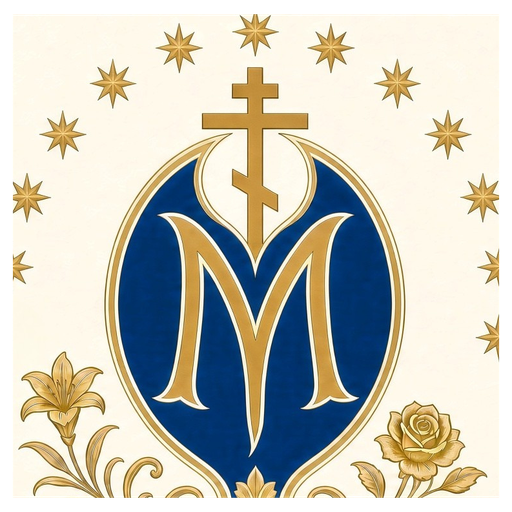
The design’s reverse makes its Christian centre unmistakable. A cross is joined to the letter M; beneath are the heart of Jesus, crowned with thorns, and the heart of Mary, pierced by a sword. Twelve stars surround the design. The imagery draws together the Passion, Mary’s participation as a mother and disciple, and the biblical world in which Christians contemplate her place in salvation history.
The two hearts do not represent equal redeemers. Jesus saves through his death and resurrection; Mary receives his salvation and remains united to him in love. Her pierced heart recalls Simeon’s prophecy and her presence at the Cross. The medal therefore invites more than affection for a beautiful image. It asks the wearer to remain close to Christ when love becomes costly and to receive his mother as a companion in faithful discipleship.
A message entrusted, not advertised
Catherine told her confessor, Father Jean-Marie Aladel, rather than presenting herself publicly as a spiritual authority. The account describes delay and difficulty before the proposal was brought to the Archbishop of Paris. Medals began to be distributed in 1832, during a cholera epidemic. Reports of healing and conversion helped give the medal its familiar name. Those reports explain the growth of the devotion without making every story of a favour a separately investigated miracle.
The Church authorized the medal and examined the developing devotion. Catherine’s canonization in 1947 concerns her holiness of life. These facts are related, but they are not identical acts. A responsible account does not collapse authorization of a devotional object, an inquiry, a liturgical feast, and a canonization into a claim that every remembered detail has received the same kind of judgement. The devotion’s place in Catholic life is clear without that exaggeration.
The most persuasive part of the story
Catherine spent the following decades at Reuilly, caring for elderly people. Her identity as the visionary was not the centre of her public life. The contrast is striking: an image associated with her testimony travelled widely, while she remained occupied with duties that did not depend on being recognized. The story’s aftermath is not an empty space between apparition and canonization. It is where her response took its enduring human shape.
The Miraculous Medal is rightly received as a sacramental associated with prayer, not as magic, medical treatment, or a promise of immunity from suffering. Catherine’s life gives it a demanding simplicity. Carrying a sign of Mary’s care should make a person more attentive to the care another human being needs. The fullest answer to the Rue du Bac is not merely to wear the medal, but to let prayer grow into patient service.
Reading the Church’s judgement
The apparitions of the rue du Bac were examined by the Archdiocese of Paris in 1836, which approved the medal and the devotion without pronouncing a formal judgement on the visions themselves — the visionary’s identity being still secret. The Holy See later granted the liturgical feast (1894), approved the Association of the Miraculous Medal (1909), and canonized Catherine Labouré (1947), whose visions the decree of canonization treats as authentic.
Together these acts place the Miraculous Medal firmly in the collection of Church-recognized apparitions, under the labels “Diocesan recognition / public devotion permitted” and “Holy See document available.”
For prayer and reflection
The Immaculate Conception · Trust · Graces asked and given
Beneath thy shelter we take refuge, Holy Mother of God; despise not thou our prayers in our necessities, and deliver us always from all dangers, Virgin glorious and blessed.
Sub tuum præsidium · general Marian prayer, not an apparition message. The Raccolta (1857), no. 76 · Ambrose St. John translation
Sources and further reading
- [1] Official shrine · Rue du Bac chapel · the apparitions and Miraculous Medal · English account, 27 November 1830https://www.chapellenotredamedelamedaillemiraculeuse.com/langues/english/apparitions-et-la-medaille-miraculeuse-gb/
- [2] Official shrine · Rue du Bac chapel · the Vincentian family and Catherine’s lifehttps://www.chapellenotredamedelamedaillemiraculeuse.com/langues/english/histoire-dune-famille-gb/
- [3] Church source · Association of the Miraculous Medal · history of the apparitionshttps://amminter.org/en/history-of-the-apparitions/